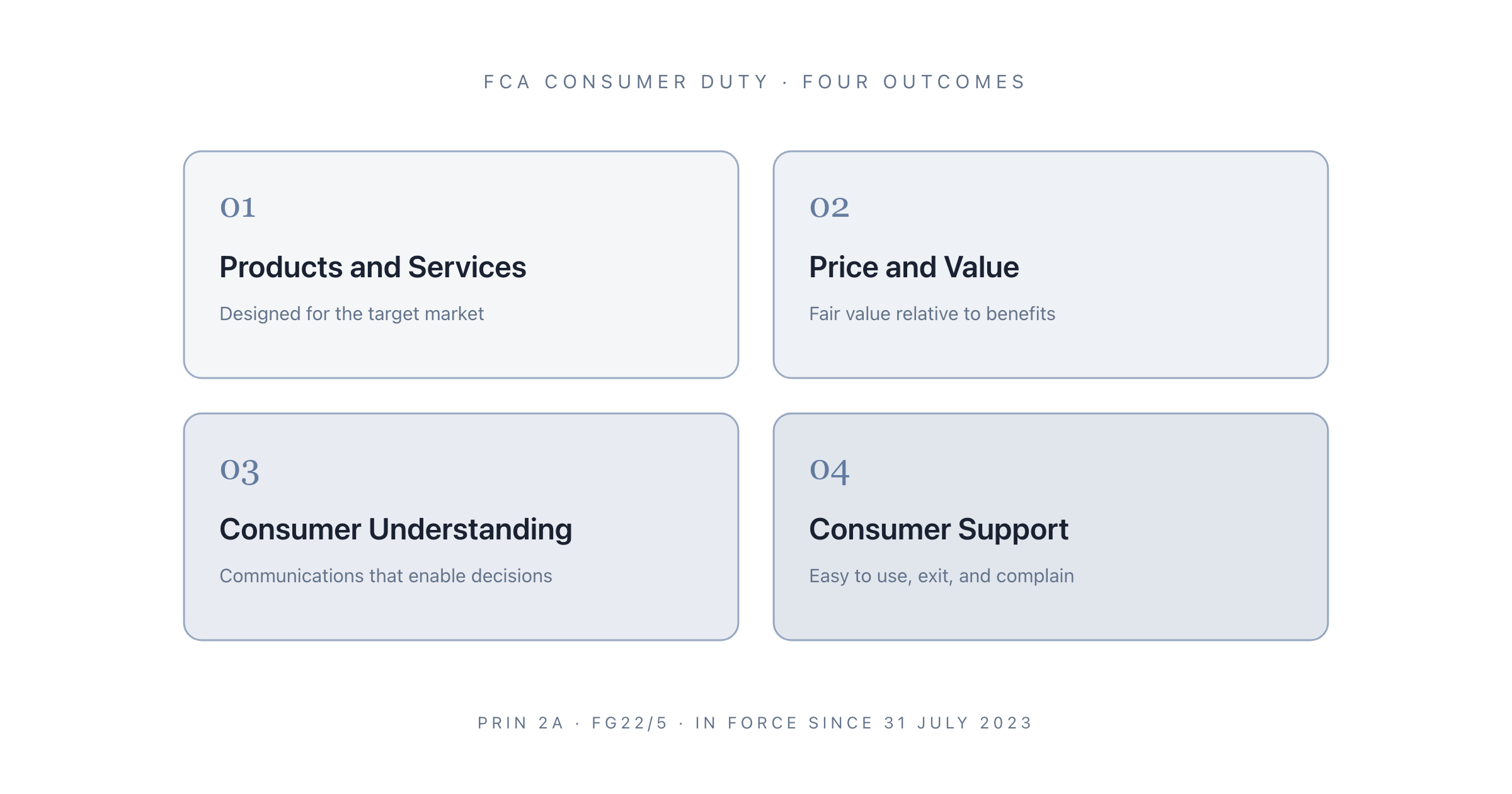
The Consumer Duty is the single most important piece of conduct regulation the FCA has introduced for UK financial advisers in a decade. At its heart sit the four Consumer Duty outcomes, the specific results the regulator expects every advised client to receive. Understand these four outcomes and you understand what the Consumer Duty actually requires in practice: not more paperwork, not more meetings, but a demonstrable trail that shows each client is getting a product that fits, at a price that is fair, communicated in a way they can act on, and supported in a way they can actually use.
This guide breaks down each of the four Consumer Duty outcomes, explains what the FCA expects advisers to evidence for each, and ends with a practical checklist you can audit your own files against. If you have already read the high-level "what is the Consumer Duty" primers and want the grown-up working version for a practising adviser, this is it.
What Are the Four Consumer Duty Outcomes?
The Consumer Duty (Principle 12, in force from 31 July 2023 for new and existing products, and 31 July 2024 for closed products) requires firms to "act to deliver good outcomes for retail customers." The regulator then specifies, across PRIN 2A and the supporting FG22/5 Finalised Guidance, four distinct outcomes that make that obligation concrete.
- Products and Services: the product or service must be designed to meet the needs, characteristics, and objectives of the target market, and distributed only to that target market.
- Price and Value: the product or service must offer fair value, meaning the benefits received by the customer must be reasonable relative to the price paid.
- Consumer Understanding: communications must equip customers to make effective, timely, and properly informed decisions about financial products.
- Consumer Support: firms must provide support that meets customer needs throughout the lifecycle of the product, with no unreasonable barriers to exiting, switching, or complaining.
Each of these is a testable standard, not a slogan. When the FCA, or a successor-firm buyer, or the FOS looks at a client file, they are asking, in effect, "can this firm show evidence that each of these four outcomes was actually delivered?" The rest of this guide walks through what that evidence looks like, outcome by outcome.
Outcome 1: Products and Services
The first Consumer Duty outcome is the most structural. It says the product has to be right for the person receiving it, and the firm has to be able to show how it confirmed that fit.
What it requires
- A documented target-market definition for every product or service you distribute, covering the needs, financial situation, objectives, and characteristics (including vulnerability characteristics) of the customers it is designed for.
- A distribution strategy aligned to that target market, so products are not being sold to customers outside it.
- A manufacturer/distributor review cycle. You must know whether the products you recommend still fit their stated target market, and raise issues with manufacturers when they drift.
- An annual review of product suitability at the client level, not just the product level.
What the FCA expects to see
- Target-market documentation from manufacturers (MiFID II product-governance files, fund factsheets, DFM mandates).
- Your own distributor-side assessment demonstrating you understand who the product is for and ruling it out for clients outside the target market.
- Annual review records showing you reassessed fit.
Where advisers typically fall short
A common failure pattern: an adviser recommends a product (typically a platform or a DFM) on the basis that it was suitable at initial onboarding, and never revisits whether the platform's pricing tier, service level, or investment philosophy still fits the client's current circumstances. That is a Consumer Duty issue as well as a suitability one.
Outcome 2: Price and Value
The price-and-value outcome is the one advisers worry about most, partly because it is the most commercially sensitive. The FCA is not mandating a particular fee level. It is mandating that fees be justifiable relative to what the client is actually receiving.
What it requires
- A fair-value assessment for every service, product, or charge the client pays, including platform fees, ongoing advice fees, DFM fees, and any bundled services.
- Demonstrable reasoning for why the total ongoing cost is reasonable given the expected benefits.
- A process for identifying and managing poor-value outcomes: situations where a client is paying for services they are not using, or where the total cost stack has drifted above what the benefits support.
What the FCA expects to see
- Documented fair-value assessments at the service level.
- Annual review records that revisit whether the client is using the services they are paying for.
- Evidence you have addressed poor-value combinations (a platform with more bells than the client uses, an ongoing-advice fee on a client who declines annual meetings).
Where advisers typically fall short
The sharpest edge here is the ongoing advice fee. If a client pays 0.75% a year for ongoing advice and has not had a meaningful advice interaction in eighteen months, the firm has a fair-value problem, regardless of how well the underlying portfolio has performed. This is the single most common theme the FCA has raised in its Consumer Duty thematic reviews.
Outcome 3: Consumer Understanding
This is the outcome where detailed meeting notes start to matter most. The Consumer Understanding outcome requires that your communications, including your verbal communications in meetings, equip the client to make good decisions. That is a higher bar than "you gave them the information."
What it requires
- Communications calibrated to the audience: reading age, financial literacy, vulnerability characteristics.
- Active testing that the customer has actually understood, especially for complex products or material decisions.
- A feedback loop: if clients routinely misunderstand a particular product feature or risk, the firm must address the communication, not just document that it was sent.
What the FCA expects to see
- Evidence of how you tailor communications to different client segments.
- For material decisions (drawdown, transfer, consolidation), a record of the conversation that shows the client understood the decision they were making, not just that they signed a declaration.
- Suitability reports written to be readable, not to be legally defensible at the expense of being followable.
- Meeting notes that capture the client's questions, their expressed understanding, and any areas where you clarified or revisited a concept.
Where advisers typically fall short
The single biggest gap: meeting notes that summarise the adviser's recommendations but do not capture the client's reactions, questions, or understanding. A Consumer Duty audit in 2025 is asking whether you can show that the client understood. A file of one-way outbound recommendations cannot answer that.
This is one of the specific areas where an AI meeting notes tool built for financial advisers changes the evidence profile. Detailed, time-stamped notes that capture the client's actual words, not a post-hoc summary, make the Consumer Understanding outcome demonstrably satisfied rather than argued for.
Outcome 4: Consumer Support
The fourth outcome is about how easy you make it for the client to use the service, raise issues, or leave. The FCA is explicit that the support provided must be at least as good throughout the lifecycle of the product as it was at the point of sale.
What it requires
- No unreasonable barriers to switching, exiting, or complaining.
- Proactive support around life events: death, ill-health, vulnerability onset.
- Response times and support quality that are consistent with what the client was led to expect.
- A complaint-handling process that is accessible and visible.
What the FCA expects to see
- Service level standards, documented and monitored.
- Records of client interactions including queries, complaints, and the response provided.
- Proactive outreach records where the firm has identified a client's changing circumstances (bereavement, diagnosis, divorce) and adjusted the service.
Where advisers typically fall short
Post-sale support tends to degrade over time. A firm that promises quarterly outreach during the initial onboarding often defaults to annual reviews only, then to no outreach at all beyond the annual review letter. The Consumer Duty does not require quarterly outreach, but it does require that the support you actually provide matches what the client was led to expect.
The Cross-Cutting Rules
The four outcomes sit inside a broader set of three cross-cutting rules that apply to every aspect of a firm's conduct:
- Act in good faith. Honest, fair, open dealing consistent with the client's best interests.
- Avoid causing foreseeable harm. Both by the firm's own actions and by its failure to act.
- Enable and support customers to pursue their financial objectives. Active help, not passive compliance.
These are the lens the FCA uses to interpret ambiguous outcome-level evidence. If a firm has technically met the documented standards for each outcome but has also, say, failed to flag a foreseeable harm, the firm has still breached the Consumer Duty.
The Practical Evidence Checklist
Print this and walk your own files against it. If you cannot tick the box, you have a gap.
Products and Services
- Documented target market for every product or service you distribute.
- Annual distributor-side assessment of product fit, not just manufacturer-side.
- Evidence you have raised issues with manufacturers when products drift from their target market.
Price and Value
- A fair-value assessment on file for every service, product, or charge the client pays.
- Annual review record that revisits ongoing-fee justification.
- Evidence of action where the client's fee-to-benefit ratio has become poor.
Consumer Understanding
- Tailored suitability reports by client segment, not a single template.
- Meeting notes that capture the client's questions, reactions, and expressed understanding.
- For material decisions (drawdown, transfer), explicit evidence the client understood before signing.
Consumer Support
- Documented service-level standards matched to what the client was promised.
- Records of proactive outreach around life events.
- Visible, accessible complaint-handling process.
Cross-Cutting
- Evidence the firm has actively prevented foreseeable harm in at least one specific situation in the last twelve months.
- Board/senior-management-level oversight and MI covering all four outcomes.
Where Meeting Notes Fit Into the Consumer Duty
Two of the four Consumer Duty outcomes (Consumer Understanding and Consumer Support) rest heavily on what actually happened in client meetings. The FCA is explicit that meeting records are one of the primary evidence artefacts a firm should produce when asked to demonstrate the Duty is being met.
A typical meeting note produced from memory, written up an hour after the meeting, captures roughly 30-40% of the conversation content, biased toward what the adviser said and against what the client said. That is the wrong side of the Consumer Duty evidence profile. The outcome you need to evidence is what the client understood, what they asked, where they hesitated, and what proactive support you identified as needed.
Heavenly records, transcribes, and structures client meetings specifically around this profile. Notes capture the full conversation in the client's own words, flag vulnerability indicators in real time, and leave an audit trail that answers "did the client understand?" with evidence rather than assertion. For advisers scaling a Consumer Duty evidence regime across a book of 150-300 ongoing clients, it is the single highest-leverage change to your file quality.
Related Reading
- The financial adviser meeting notes template for a practical template you can use today.
- Cash flow modelling for financial advisers for the workflow where Consumer Understanding bites hardest.
- Paraplanner: the adviser's guide for how to structure the advice team around Consumer Duty evidence expectations.
FAQ
How many Consumer Duty outcomes are there?
Four. Products and Services, Price and Value, Consumer Understanding, and Consumer Support.
What are the four Consumer Duty outcomes?
They are, in order: Products and Services (the product fits the target market), Price and Value (the price is fair relative to benefits), Consumer Understanding (communications equip the client to decide), and Consumer Support (the service is easy to use throughout the lifecycle).
When did the Consumer Duty come into force?
31 July 2023 for new and existing products and services. 31 July 2024 for closed products and services.
Does the Consumer Duty apply to financial advisers?
Yes. The Consumer Duty applies to all firms in the retail distribution chain, which includes financial advisers, wealth managers, and planners giving advice to retail clients.
What is the difference between the cross-cutting rules and the outcomes?
The three cross-cutting rules (act in good faith, avoid foreseeable harm, enable customers to pursue objectives) are the broad obligations. The four outcomes are the specific results those obligations produce for clients. Both apply, and the FCA looks at evidence across both.
Are meeting notes enough to evidence Consumer Duty?
Not on their own, but they are one of the most important evidence artefacts, particularly for Consumer Understanding and Consumer Support. The FCA has repeatedly highlighted that records of client interactions are expected to be part of a firm's evidence base.
The Short Version
The four Consumer Duty outcomes (Products and Services, Price and Value, Consumer Understanding, Consumer Support) are the specific results every advised client must receive. Each is testable. Each requires evidence. The advisers who are landing well in early FCA reviews are the ones who have moved their files from "summary notes" to "full evidenced conversations" and built annual-review and fair-value processes around the outcome definitions, not around legacy suitability templates.
If you want to see how automated meeting notes improve your Consumer Duty evidence profile, book a demo of Heavenly. It takes about fifteen minutes and you can run it on a recorded client meeting of your own.