Discretionary fund management is the part of the UK advice chain where someone other than the adviser is making the trades. The client signs an investment management agreement, the adviser writes a mandate (risk profile, objectives, exclusions), and from that point the DFM rebalances, switches funds, manages tax events, and reports back without needing the client (or, usually, the adviser) to sign off each trade. For some advisory firms, outsourcing to a DFM frees up several hundred adviser hours a year that would otherwise go to portfolio admin. For others, it adds a layer of cost and a Consumer Duty assessment that does not pay back. The decision matters more than it is usually given credit for.
This guide is the practical one for UK financial advisers in 2026: what DFM is and how it differs from running your own bespoke portfolios or using an MPS, when the outsourcing economics actually work, what the current fee benchmarks look like, the due diligence checklist for selecting a DFM, the Consumer Duty implications, and where AI meeting notes speed up the part of the process that takes the longest. If you want the meeting-notes part wired into your existing CIP today, Heavenly drops into the workflow without changing your back-office stack.
What Discretionary Fund Management Actually Is
Discretionary fund management is an investment service in which the manager has been delegated authority by the client to make investment decisions on their behalf, within an agreed mandate, without seeking client (or adviser) approval for individual trades. The mandate sets the boundaries: risk profile, asset allocation ranges, ethical or sector exclusions, liquidity requirements, performance benchmark. Everything inside those boundaries is the manager's call.
That delegation is what distinguishes DFM from advisory services. In a pure advisory relationship, the adviser recommends and the client signs off on each material change. In an MPS (model portfolio service), the adviser typically signs off on rebalances or model updates on the client's behalf, but the underlying trades sit on a defined model rather than a bespoke decision. In DFM, the manager simply trades.
There are two structural flavours of DFM you will meet in the UK:
Bespoke DFM. A portfolio constructed for a single client, usually from a starting AUM threshold of £250,000 to £500,000, sometimes higher. The mandate is tailored, the holdings are unique, and the manager (or their team) has discretion within the bespoke framework. Bespoke DFM is the original product.
Managed Portfolio Service from a DFM (DFM-MPS). Effectively a model portfolio service offered by a discretionary firm, available on platform from minimums as low as £25,000. The "discretionary" part is real (the DFM rebalances and switches without client sign-off), but the portfolios are off-the-shelf models rather than bespoke constructions. This is the high-volume, low-margin variant that has dominated the UK market since around 2015.
Both are legitimately "discretionary fund management". The economics, the due diligence, and the Consumer Duty assessment differ significantly between them.
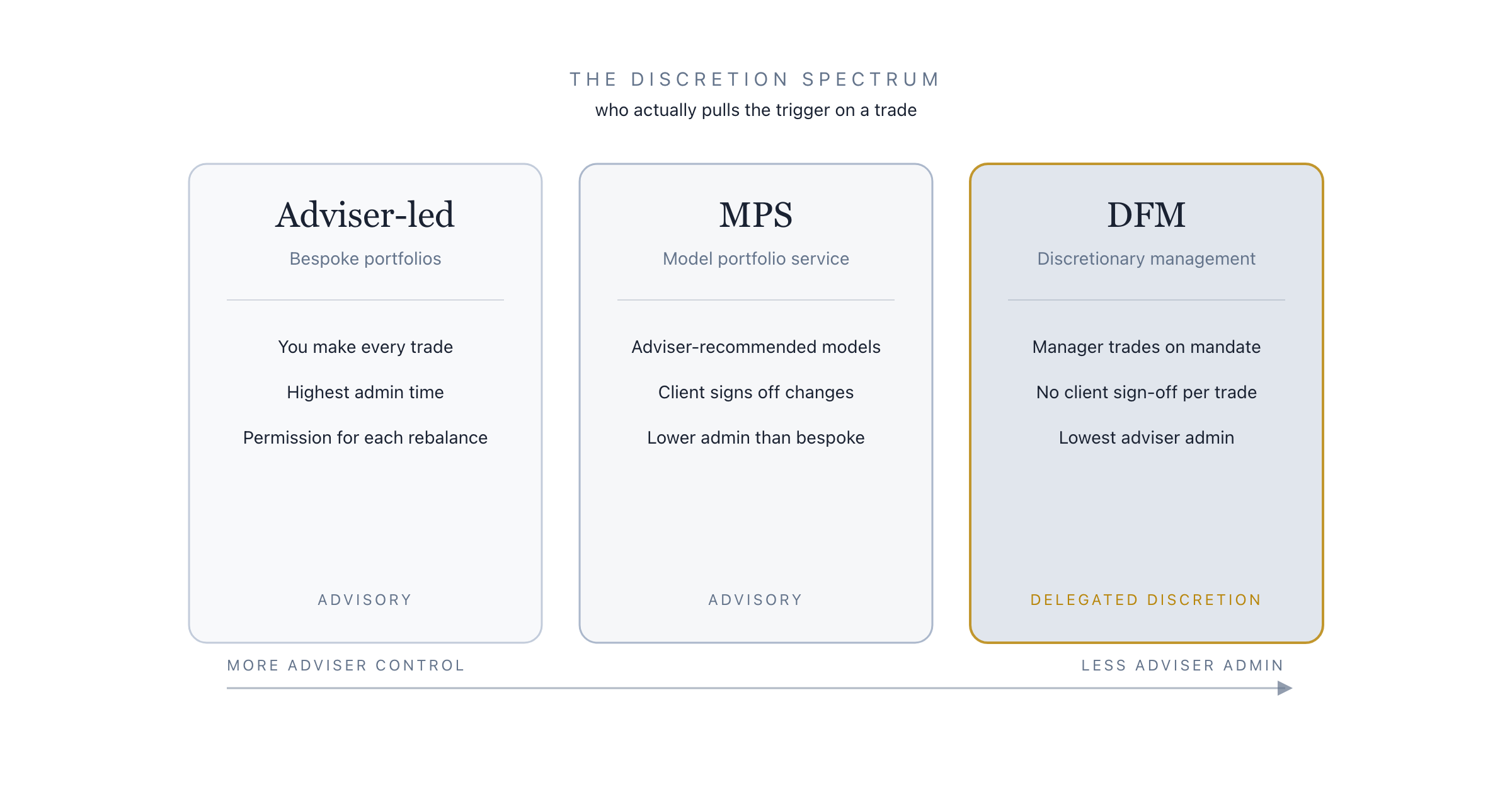
Where DFM Sits on the Discretion Spectrum
Think about three columns:
-
Adviser-led bespoke portfolios. You pick the funds, you size the holdings, you sign off on every rebalance, you manage the tax events, you write the rebalance rationale. The client sees a recommendation each time, signs an authority, and the platform executes. Highest adviser control, highest adviser admin time. Sustainable at small client numbers; unsustainable above maybe 80 to 120 client portfolios per adviser depending on complexity.
-
MPS run by your own firm. You construct three to seven model portfolios across a risk spectrum, each client maps to one, and rebalances happen on a schedule (typically quarterly). Sign-off process varies. Less admin than bespoke, but you still own the investment decisions, the rebalance discipline, the model documentation, and the regulatory permissions to run discretionary models if that is the structure.
-
DFM (bespoke or DFM-MPS). A third party manages the portfolios. You handle the client relationship, the planning, the suitability, the ongoing review. The DFM handles the investment decisions. Lowest adviser admin on the investment side; highest layer of assessable cost in the chain.
The decision among these three is a centralised investment proposition (CIP) decision, made at the firm level, not on a per-client basis. The FCA expects the CIP to be documented, evidence-based, and reviewed periodically. The choice of DFM (or not) is a structural decision about the firm, not just a product selection.
When Outsourcing to a DFM Actually Makes Sense
The DFM sales pitch is usually some version of "we free you up to focus on planning". That is true in principle. In practice, the economics work in three specific situations.
1. The firm is growing past adviser-investment-decision capacity. A single adviser can run bespoke portfolios for maybe 80 to 120 clients depending on complexity. Beyond that, either the rebalance discipline slips or the planning conversations get crowded out. A DFM solves both problems by removing the rebalance work entirely. The break-even point depends on the average client AUM and the fee differential, but for firms with average client portfolios above £150,000, outsourcing typically saves more in adviser hours than it costs in DFM fees.
2. The firm wants to demonstrate independence from the investment side. Some firms structurally prefer not to be making investment calls, partly for risk management (an investment loss has a clear external owner) and partly for the planning-first positioning. Splitting the planning and the investment management between two firms is cleaner than running both functions in-house and trying to keep the audit trail separate.
3. A specific client mandate genuinely requires bespoke discretionary management. Concentrated stock positions, tax-sensitive estate work, charitable trusts with specific ethical mandates, and ultra-high-net-worth clients with complex liability matching are all situations where bespoke DFM may be the right answer for that client even if the firm uses MPS for most of its book. The Consumer Duty fair-value assessment for that client is more straightforward when bespoke is genuinely the right tool.
When DFM does not work as well: small portfolios under £100,000 where the layered fees compound noticeably, simple cases where a low-cost MPS offered by a low-cost provider is functionally equivalent, and firms that want very tight control over fund selection (in which case the outsourcing actively gets in the way).
DFM Fees in 2026: What to Benchmark Against
The DFM fee landscape in the UK has compressed significantly since around 2018. Bespoke DFM used to charge 0.75% to 1.0% per year on top of fund and platform costs; that has fallen to around 0.45% to 0.85% for most established providers. DFM-MPS sits lower, typically 0.15% to 0.35% per year.
A practical 2026 benchmark, expressed as the all-in client cost (DFM + funds + platform + adviser) for a £500,000 portfolio:
- Adviser-led bespoke: 1.4% to 2.0% all-in (adviser 0.75% to 1.0%, funds 0.30% to 0.50%, platform 0.20% to 0.45%)
- In-house MPS: 1.3% to 1.8% all-in (similar adviser fee, slightly lower fund cost where passive sleeves are used)
- DFM-MPS via platform: 1.5% to 2.0% all-in (DFM 0.20% to 0.35% on top of the equivalent fund and platform costs)
- Bespoke DFM: 1.7% to 2.4% all-in (DFM 0.50% to 0.85% on top, plus typically slightly higher fund costs from active selection)
These are central tendencies and there are outliers in both directions. The number that matters for a Consumer Duty fair-value assessment is the marginal cost of the DFM layer relative to the marginal benefit, not the absolute level. A 0.30% DFM-MPS layer that saves an adviser 30 hours a year per 100 clients is materially different in fair-value terms from a 0.85% bespoke DFM layer that does not change the time saved per client because the firm was already running bespoke portfolios.
The DFM Due Diligence Checklist
If you are selecting or reviewing a DFM, the FCA expects documented, evidence-based due diligence. The framework most firms use covers six areas:
Investment process. Documented investment philosophy, asset allocation framework, fund selection criteria, rebalancing discipline, risk management framework. Ask for the most recent investment committee minutes, anonymised if necessary. A DFM that cannot produce two years of committee minutes does not have a documented process.
Performance. Three- and five-year performance against a comparable benchmark, ideally net of all fees, ideally a peer-group benchmark like ARC PCI or PIMFA private indices rather than a market index. Be sceptical of selective period reporting.
Fees and total cost of ownership. All-in cost including fund OCFs, transaction costs, platform fees if applicable, and the DFM's own ongoing charge. Pre-MiFID-II disclosure was patchy; post-MiFID-II disclosure is better but still requires reading. The relevant comparison is total cost in your hands versus total cost in the next-best alternative.
Service and reporting. Cadence of client reporting, quality of adviser-facing portal, response times to enquiries, named relationship manager, and whether reporting can be branded for your firm. A DFM that does not provide adviser-friendly portfolio reporting will create work for you, not save it.
Regulatory standing. FCA permissions, capital adequacy, ownership structure, complaints history (FOS data is public), and any ongoing or recent regulatory actions. Required as part of the firm-level due diligence regardless of how comfortable you are with the firm informally.
Cultural fit and continuity. Investment team turnover, key-person risk, parent company ownership and any recent changes, and whether the DFM's approach is aligned with your firm's planning style. A DFM that is being acquired, restructured, or shedding key staff is a higher-risk relationship even if the current performance and fees look fine.
The output of due diligence should be a written assessment, signed off by the firm's investment committee or equivalent, and reviewed at least annually. Many firms now do this as part of an annual CIP review.
Consumer Duty Implications
Consumer Duty changes the nature of the DFM decision from "is this product suitable for this client" to "is the overall service delivering fair value to clients in the target market". The four outcomes (products and services, price and value, consumer understanding, consumer support) all apply.
Three Consumer Duty pressure points are worth specific attention:
Fair value at the layered-fee level. Where a client pays adviser fee + DFM fee + fund OCF + platform fee, the regulator expects firms to assess fair value across the whole stack, not just the components individually. A 1.8% all-in cost can be fair value or not depending on what the client is actually getting.
Target market alignment for DFM-MPS. A DFM-MPS portfolio designed for a "balanced growth" target market that is being used for a client whose objectives are actually "capital preservation" is a target-market mismatch. The DFM provides the target market definition; the adviser is responsible for matching individual clients to the right target market.
Quality of consumer understanding. The DFM relationship adds a party to the chain that the client needs to understand. The Consumer Understanding outcome requires you to be able to evidence that the client knows who is making investment decisions on their behalf, what discretion has been delegated, and how to make a complaint about each party. This is rarely a one-page document.
The pre-Consumer Duty framing of DFM as a back-office investment decision has not survived. Post-2023, DFM is a customer-facing service that needs to be assessed and disclosed accordingly.
Where AI Meeting Notes Speed Up the Process
The part of the DFM workflow that consumes the most adviser time, after the initial selection, is the ongoing review meetings: the adviser-DFM checkpoint, the adviser-client review, the suitability-update conversations triggered by client life events. Each of those requires note-taking, action capture, and follow-up.
Heavenly is built to remove the manual note-taking step from each of those meetings. The adviser holds the client review the way they would anyway. Heavenly produces structured notes in the adviser's voice (not a meeting transcript), captures the action items, and writes them into the back-office system on the same day. The result is roughly 30 to 60 minutes of adviser time recovered per client review. For a firm running 200 client reviews a year, that is 100 to 200 adviser hours.
The DFM relationship works precisely because of those reviews. AI meeting notes do not change the DFM economics, but they materially change the adviser's ability to keep the relationship documented to the standard the regulator now expects. Combine the meeting notes template with a DFM relationship and the ongoing review process becomes something a small firm can run sustainably across hundreds of clients without sacrificing the planning depth that justified outsourcing in the first place.
The Short Version
Discretionary fund management is the part of the UK advice chain where the investment trades happen without the adviser pulling the trigger. It comes in two shapes: bespoke (high-AUM, single-client mandates) and DFM-MPS (off-the-shelf models with discretionary rebalancing). The firm-level decision to outsource to a DFM is a centralised-investment-proposition decision and should be documented, evidence-based, and reviewed annually. The fee benchmarks have compressed; the Consumer Duty bar has risen.
For most growing firms, the DFM-MPS variant is the practical answer for most clients, with bespoke DFM reserved for the specific cases where it genuinely earns its fee. The marginal cost of the DFM layer is justified by adviser hours released, not by investment outperformance: outperformance is rare and usually within statistical noise, but admin time saved is real and reliable. Pair DFM with an AI meeting notes workflow and the freed-up time goes back into the planning conversations that the DFM was supposed to enable. Used well, the combination changes the economics of running a planning-first firm with hundreds of clients.